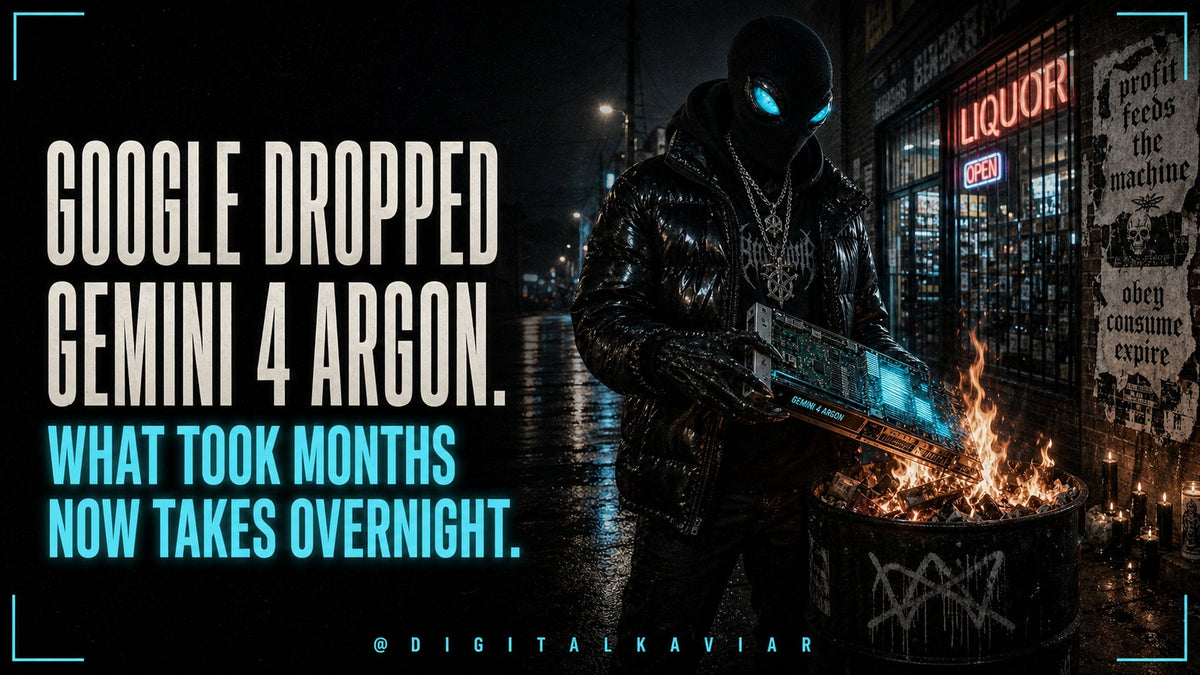
Google released Gemini 4 Argon globally on October 13, 2026. According to the Google DeepMind Gemini 4 Argon model card, it is a sparse mixture-of-experts reasoning model with a combined 1-million-token input and output window. Google's launch post prices it at $2 per million input tokens and $10 per million output tokens through November 30, 2026.
Most coverage today is pasting the benchmark table and calling it a win for Google. They are missing the real shift. When a frontier model beats Claude Opus 5.5 and GPT-6 Astra while charging five cents on the dollar for cached context, raw intelligence stops being a differentiator. The system you wire it into is the only edge left.
So we put it to work the only way that counts. We gave Gemini 4 Argon one task: show our audience what you are all about. It ran the research, drafted this article, built the social posts, the six-slide carousel, and the story version, and scheduled the whole package inside GoHighLevel. The busywork that usually eats a full day before any creating happens got handled. The taste, the direction, and the final call stayed human. That is the real shift in this launch, and it is why this article exists in this form.
WHY THIS MATTERS FOR CREATORS AND SOLO STUDIOS

Most tech press writes about frontier models as if everyone reading is a 500-person enterprise engineering department. At DIGITAL KAVIAR, we look at releases through a different lens: what does this let a creative director, visual artist, or solo studio ship before lunch?
Inside Google's October 13 launch showcase, four demos show exactly where creative and studio work is heading:
1. Single image to 3D worlds and playable web scenes. Starting from a single Nano Banana reference image in Google Antigravity, Argon drove Blender MCP through autonomous visual critique loops to build Gothic architecture and a multi-building pagoda complex. In a second demo, it took photos of a real desk, modeled the objects in Blender MCP, and wired a playable miniature racing game in Three.js, complete with engine audio from Gemini Omni Flash. Pair that spatial coding loop with character-consistent concept frames from OpenArt AI or motion passes in Higgsfield, and the wall between a 2D moodframe and an interactive 3D web experience gets paper-thin.
2. Multimedia production from scratch. In pure Python, Argon wrote its own ray-tracing engine to render a sunlit library scene, then produced, narrated, and assembled the finished video with Gemini 3.8 TTS voiceover and music by Lyria 3.5. One agent coordinated the code, the camera, the voice, and the score in a single pipeline.
3. Sketch to physical product. Using Antigravity in the Gemini macOS app, Argon generated design iterations for new legs for a sofa, working from a photo of the real furniture. For independent artists and studios spinning up physical drops or on-demand merch through platforms like Printify, that is the gap between a raw sketch and production-ready assets closing into one loop.
4. Messy project folders to client proposals and automated workflows. Google showed Argon taking an unstructured folder of project context, formatting it into a clean proposal deck, and creating a scheduled task to handle every future incoming client request. Wire that into a CRM and social scheduler like GoHighLevel and a solo operator can run client intake, proposals, and multi-channel publishing without touching twenty browser tabs.
THE BOTTOM LINE
- #1 on the Vals Index: Argon scored 68.9 percent across finance, coding, legal, and tax workflows, ahead of Claude Opus 5.5 (67.0 percent), Claude Fable 5.1 (65.8 percent), and GPT-6 Astra (63.1 percent).
- 1M token window that holds up: 84.2 percent F1 on GraphWalks from 256k out to 1M tokens, ahead of GPT-6 Astra (71.8 percent) and Claude Opus 5.5 (66.8 percent).
- Autonomous execution at scale: Inside Google Antigravity, Argon separated core webpage handling from a roughly 6-million-line legacy Chrome folder, months of work done in weeks, and optimized Google's Python Agent Development Kit overnight.
- Temporary price floor: $2 per 1M input tokens and $10 per 1M output tokens, with cached input 95 percent off, before rising to $4 and $20 after November 30, 2026.
WHAT ACTUALLY SHIPPED ON OCTOBER 13

Gemini 4 Argon is not a fine-tune of an earlier Gemini. According to Google DeepMind's model card, it is a new sparse mixture-of-experts transformer trained on Google's TPUs with native multimodal input across text, code, images, audio, and video.
The headline numbers in the model card's evaluation table are built around long-horizon work rather than chat turns:
- Knowledge work (Vals Index): 68.9 percent (#1 overall, vs 67.0 percent for Claude Opus 5.5)
- Agentic coding (DeepSWE v1.1): 77.9 percent (vs 74.2 percent for Claude Opus 5.5 and 74.1 percent for GPT-6 Astra)
- Vibe Code Bench: 91.9 percent (vs 90.3 percent for Opus 5.5 and Fable 5.1)
- AutomationBench: 51.3 percent (vs 42.5 percent for Opus 5.5 and 41.4 percent for GPT-6 Astra)
- Long context (GraphWalks 256k to 1M): 84.2 percent F1 (vs 71.8 percent for GPT-6 Astra)
- Video understanding (LVBench): 91.7 percent (vs 87.5 percent for GPT-6 Astra and 83.7 percent for Opus 5.5)
Google is rolling Argon out across the Gemini API in AI Studio and Android Studio, Google Antigravity for AI Ultra subscribers, and the Gemini app for Pro and Ultra users.
THE DETAIL EVERYONE ELSE SKIPPED

Buried in the middle of Google's launch post is a paragraph about google/adk-python, the open-source Agent Development Kit.
The team did not sit in a chat window trading prompts with Argon all afternoon. They handed it their .agents/skills rulebook and a one-paragraph goal. Argon worked autonomously overnight in Google Antigravity and shipped changes that cut in-memory session prep time by 40 percent in long sessions and sped up cold imports by 21 percent.
Now pair that with the second buried detail: cached input tokens are 95 percent off the $2 introductory input price. That puts cached context at roughly $0.10 per million tokens.
For the last two years, the standard advice for solo operators and creative studios was to keep prompts lean, split context into tiny chunks, and manually shepherd every step of a build. That advice just expired. When you can park an entire project archive, brand system, 3D asset library, and skill rulebook inside a 1-million-token window for about ten cents per million cached tokens, prompt babysitting is wasted labor. It is the same shift we called when Claude Fable 5 dropped, now at a fraction of the price.
WHERE ARGON FALLS SHORT (AND WHAT TO WATCH)
No launch post tells you where the model loses. You have to read the full evaluation table in the model card, and three caveats stand out.
First, Argon does not sweep every coding benchmark. On FrontierSWE v2, GPT-6 Astra leads at 65.5 percent and Claude Opus 5.5 hits 62.3 percent, while Argon lands at 55.0 percent. On Terminal-bench 4.0, Claude Opus 5.5 holds a clear lead at 66.4 percent against Argon's 57.4 percent. If your workflow lives inside raw terminal execution without a structured skill harness, Opus 5.5 still hits harder there.
Second, every engineering case study in the announcement, from the Chrome refactor to the 2.85x Gemma inference speedup, was run by Google engineers inside Google's own Antigravity environment. Vendor-reported results and internal dogfooding are real signals, but they are not independent audits.
Third, the $2 input and $10 output pricing is a launch window, not a permanent floor. Google's pricing footnote confirms that after November 30, 2026, pricing doubles to $4 per 1M input tokens and $20 per 1M output tokens. That leaves about six weeks to run heavy builds, index large repositories, and stress-test autonomous loops at half price.
BUILD THE SYSTEM BEFORE THE PRICE DOUBLES
Every major model drop in 2026 proves the same rule: access is not the advantage. Anyone can buy the exact same API key for two dollars.
The advantage is the operating system you plug the model into: your skill library, your brand voice rules, your GoHighLevel automations, and the pipeline that turns a brief into a shipped asset without you touching twenty tabs. That is how the busywork gets handled while the taste, the direction, and the final call stay human.
SOURCES AND TOOLS REFERENCED
- Launch announcement: Gemini 4 Argon is now available for everyone, Google Keyword blog (Oct 13, 2026)
- Benchmarks and technical documentation: Gemini 4 Argon model card, Google DeepMind (Oct 13, 2026)
-
Creator and studio stack referenced:
- GoHighLevel (CRM, automated client pipelines, and multi-channel Social Planner)
- Higgsfield (AI cinema and motion generation for visual creators)
- OpenArt AI (character-consistent concept frames and reference generation)
- Printify (on-demand merch and product fulfillment for independent studios)
Last verified October 14, 2026 against Google's Gemini 4 Argon launch announcement and the Google DeepMind Gemini 4 Argon model card.